Psychology Basics Made Simple: Understanding Psychology in Everyday Life

A delayed text. A sharp reply you regret. A week of stress that somehow becomes a month. Most of us meet psychology not in a classroom, but in moments like these—when a feeling arrives too fast, a pattern repeats, or someone else’s behavior stops making sense.
This guide covers psychology basics in plain language, with enough depth for a sophisticated reader and practical takeaways you can use the same day. You will learn what psychology actually studies, how schemas and attachment shape ordinary life, and how to apply a few reliable tools to communication, stress, learning, and self-understanding.
Key Takeaways
Psychology is the scientific study of mind and behavior. Psychology basics give you a usable map of thoughts, emotions, habits, and relationships.
Much of what feels “personal” is patterned. Schemas, attachment styles, and coping strategies help explain why the same situations keep landing the same way.
Psychology’s practical goals are to describe, explain, predict, and change behavior in ways that reduce suffering and increase flexibility.
You do not need to become a clinician to benefit. Small, repeated skills—naming emotions, testing thoughts, repairing ruptures, and regulating your nervous system—compound quickly.
When patterns feel stuck, evidence-based therapy can help you work with the deeper layers rather than only managing symptoms.
What is Psychology?
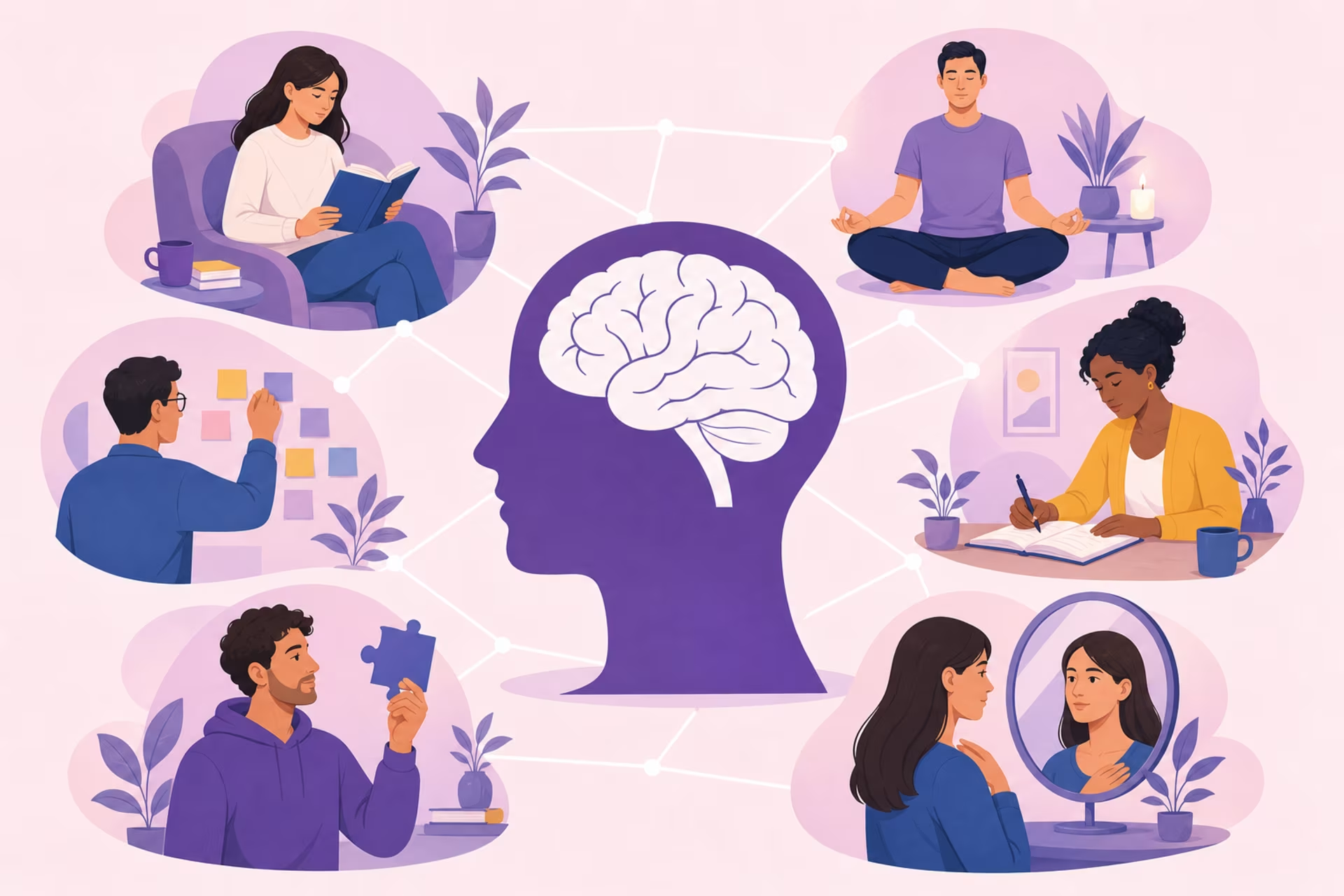
Imagine you are sitting in traffic after a tense email. Your chest tightens. You rehearse a sharp reply. Then you notice a song from years ago and, for a second, feel oddly sad. That sequence—body, thought, memory, urge—is exactly the kind of territory psychology studies.
Psychology is the scientific study of the mind and behavior. It looks at conscious experience and the quieter processes underneath it: attention, memory, emotion, learning, motivation, personality, and social influence. The word comes from the Greek word psyche (mind or soul) and logos (study), and the field’s roots reach back to ancient Greece around 400–500 BC, but modern psychology is a scientific discipline focused on understanding the human mind, not a set of slogans.
Philosophers asked psychological questions for centuries. William James defined psychology as the study of mental life and published The Principles of Psychology in 1890. Psychology became a formal science in 1879, when Wilhelm Wundt opened the first experimental laboratory. From there, the history of psychology branched into research and practice: laboratories measuring perception and memory, clinics treating anxiety and depression, schools supporting learning, workplaces studying motivation, and communities examining belonging and bias. The American Psychological Association was established in 1892.
For everyday life, the useful definition is simple. Psychology helps you notice the machinery behind experience so you can respond with more choice and less autopilot.
What Are Psychology Basics?

Psychology basics are the foundational ideas that give you a basic understanding of the field and make the rest of it readable: how people think, feel, learn, relate, and change. They are not “Psychology Lite.” They are the operating system.
In practice, the questions tend to sound like this:
Why do I overreact in some situations and shut down in others?
Why do the same relationship conflicts keep returning?
How do habits form, and how do they change?
What is the difference between a mood, a personality trait, and a mental health condition?
Which tools actually help with stress, focus, and communication?
A solid grasp of psychology basics helps you do three things well. First, you can name what is happening with more precision. Second, you can separate a temporary state from a longer pattern. Third, you can choose interventions that match the problem instead of throwing random self-help at everything.
Advanced psychology goes deeper into specialized research and clinical methods. Psychology basics give you the frame that makes understanding the human mind and behavior more usable.
Psychology Basics: Core Concepts and Theories
A few core concepts do most of the heavy lifting in daily life.
Cognition is how you take in, interpret, store, and use information. Memory, attention, and decision-making sit here. Heuristics are mental shortcuts for quick decisions, and cognitive biases are systematic errors in thinking that can shape judgment. If you keep “forgetting” a hard conversation, that may be avoidance as much as memory failure.
Emotion is not the opposite of reason. Emotion is information about needs, values, and perceived threat or opportunity. Anger often points to a boundary. Anxiety often points to uncertainty or danger. Shame often points to belonging and worth, and motivation is sometimes framed through Maslow’s hierarchy of needs as people move from basic needs toward higher goals.
Behavior is what you do—and what you stop doing. Psychology pays close attention to reinforcement: what gets rewarded tends to repeat, even when the long-term cost is high.
Personality and individual differences help explain stable tendencies across time. Two people can face the same setback and tell completely different stories about what it means.
Major theoretical traditions offer different lenses. Cognitive approaches focus on thoughts and interpretations. Behavioral approaches focus on learning and contingencies. Humanistic approaches emphasize growth, meaning, and agency. Psychodynamic approaches look at the unconscious mind, early experience, and inner conflict, a tradition shaped by Freudian theory and psychoanalytic theory. Social psychology examines how groups, norms, and situations shape us. You do not need to pick a favorite school. In practice, the best clinicians borrow what works.
Here is a quick way to use those lenses on a real problem. Suppose you keep canceling plans and then feel lonely. A cognitive lens asks what story you tell yourself before you cancel. A behavioral lens asks what immediate relief cancellation provides. A humanistic lens asks what need for authenticity or rest is underneath. A social lens asks whether the group context feels unsafe or mismatched. Psychology basics become powerful when you can hold more than one explanation at once.
Field note: If a single explanation makes you feel either totally blamed or totally powerless, it is probably too narrow. Useful psychology leaves room for learning history, current stressors, biology, and choice.
Psychology Basics: How Patterns Build From Small to Large
One of the most useful psychology basics is this: psychological difficulties often scale. They can begin as a specific belief, widen into a relational style, show up as a clinical symptom pattern, and—in more entrenched cases—organize personality functioning itself.
Think of it as a ladder of pattern size.
Core Beliefs (Schemas)
At the smallest level are core beliefs, often called schemas. A schema is a deep organizing belief about yourself, other people, or relationships. It acts like a filter. Once activated, it colors what you notice and what you ignore.
Take an abandonment schema: “People I care about will leave.” When that belief is triggered—say a partner replies slowly—a familiar chain can start:
Automatic thoughts: “They are pulling away.” “I care more than they do.” “I am too much.”
Emotions: fear, loneliness, urgency, jealousy.
Urges: seek reassurance, protest, withdraw first, or monitor constantly.
Behaviors: repeated texting, checking, accusing, overexplaining, or shutting down.
Those behaviors can create the very outcome the schema fears. Pressure invites distance. Distance “proves” the belief. The loop tightens.
Try this: When you feel a sudden surge, pause and write one sentence for each link: trigger → thought → feeling → urge → action. Naming the chain is often the first break in the loop.
Common schema themes include abandonment, defectiveness/shame, mistrust, emotional deprivation, failure, and unrelenting standards. You do not need a full schema inventory to benefit. You need enough awareness to catch the story before it runs the day.
Schemas are sticky because they are efficient. The mind prefers a familiar story to an uncertain one, even when the familiar story hurts. That is why insight alone is rarely enough. You also need new experiences that compete with the old prediction—moments where you ask for support and receive it, set a boundary and survive the discomfort, or sit with uncertainty without forcing closure.
Mini practice: Pick one recurring schema theme and write three columns: evidence for the belief, evidence against it, and a more precise update. “People leave” might become “Some relationships end, and I can tolerate uncertainty while I gather more information.” Precision weakens absolute claims.
Attachment Styles
Attachment styles sit one level up. They are patterned ways of seeking closeness and managing threat in important relationships. They often grow from clusters of schemas plus repeated coping moves.
Anxious attachment may include fears of abandonment, hypervigilance to rejection cues, and protest behaviors. Avoidant attachment may include discomfort with dependence, minimizing needs, and pulling away when intimacy rises. Secure attachment is not perfect calm. It is the capacity to stay connected while distressed and to repair after rupture.
Attachment primers often pause to define ambivalence as mixed approach–avoid motives, especially in anxious and avoidant patterns.
Important nuance: an attachment style is a relational pattern, not a personality disorder. It often shows up most strongly with romantic partners or family, and it can shift with insight, corrective relationships, and therapy.
Try this: After a conflict, ask two questions before you act: “Am I seeking closeness, safety, or control right now?” and “What would a repair attempt look like in one sentence?”
Attachment patterns also show up in subtler places: how you handle feedback at work, how quickly you assume rejection in friendships, and how you recover after disappointment. The goal is not to diagnose your partner or yourself with a label. The goal is to recognize the dance early enough to change one step.
A practical distinction helps: protest behaviors try to close distance fast (pursuit, accusation, testing). Deactivating strategies try to reduce need (minimizing, delaying, intellectualizing). Both can be understandable. Both can become costly when they are the only moves available.
Clinical Disorders (Previously Called Axis I)
Clinical disorders, or mental disorders in plain language—anxiety disorders, depression, OCD, PTSD, and others—also involve beliefs, emotions, and coping behaviors. A panic attack is usually something the person wants gone. A hard month of depression is the same: they want energy back. OCD is a different problem — the rituals feel unwanted, not like a choice. PTSD is different again: the nervous system is still treating the past as present. That is why the intervention has to match the pattern, not a generic self-help list. A key difference is that they are often ego-dystonic: the person experiences them as distressing and not fully “who I am.”
That matters clinically. Patterns experienced as problems are usually more workable. Someone with panic attacks typically wants the panic to stop. Someone with major depression usually wants energy and hope back. Treatment can target symptoms, thoughts, behaviors, and nervous-system patterns without needing to rebuild an entire identity structure first, and it often addresses mental illness, mental health issues, and related mental health problems when they interfere with daily functioning.
It can also help to notice comorbidity and overlap without collapsing everything into one label. Anxiety can travel with insomnia. Depression can travel with irritability. Trauma responses can look like personality rigidity until safety returns, and some symptoms involve significant mental distress, which is one reason professional assessment matters. Psychology basics teach you to stay curious longer before you conclude.
Personality Disorders (Previously Called Axis II)
At the broadest level are personality disorders: longstanding, inflexible patterns across work, family, friendships, identity, and goals. These patterns are often ego-syntonic, meaning they feel like “me” rather than an unwanted symptom. They typically involve insecure attachment and deeply held schemas that organize how a person experiences self and others.
Change is still possible. It usually requires longer, structured therapy and a focus on patterns across contexts, not only on one crisis. Distinguishing schema activation, attachment protest, clinical symptoms, and personality-level rigidity helps people stop using one-size-fits-all advice for very different problems.
Why include this in a psychology basics guide? Because searchers often arrive with a private fear: “Is this just stress, or is something deeper going on?” A hierarchical map does not replace assessment, but it reduces panic and self-blame. A triggered schema is not the same as a lifelong character verdict. A hard month of depression is not the same as an inflexible personality pattern. Matching the level of the problem to the level of the intervention is one of the most practical skills psychology offers.
Visual Summary: From Small to Large Psychological Patterns
| Level | What it is | Scope |
|---|---|---|
| Core beliefs (schemas) | Deep filters that trigger thoughts, emotions, urges, and behaviors | Internal experience |
| Attachment styles | Clusters of beliefs and coping moves in close relationships | Relationship domain |
| Clinical disorders | Ego-dystonic symptom patterns such as anxiety, depression, OCD | Situational / symptomatic |
| Personality disorders | Ego-syntonic, pervasive patterns across identity and life domains | Broad functioning |
In short: many difficulties begin with specific core beliefs, expand into patterned ways of relating, and—when deeply entrenched—shape broader personality functioning.
The Goals of Psychology

Across research and practice, psychology keeps returning to four goals. They are easy to remember and surprisingly practical.
Describe
Description means getting clear about what is happening without immediately judging it. “I snapped at my partner after a long day” is more useful than “I am a terrible person.” Precise description is the start of every good intervention.
Tip: Replace global labels with concrete observations for one week. Track situation, body sensation, thought, and action.
Explain
Explanation asks why a pattern makes sense given history, learning, biology, and context. A shutdown response may be protective if conflict once meant danger. An overworking habit may have been rewarded for years.
Tip: Ask, “What problem was this behavior solving at some point?” Compassion gets easier when behavior has a function.
Predict
Prediction uses patterns to anticipate what comes next. If late-night scrolling reliably worsens morning anxiety, you can predict the cost before you pay it.
Tip: Identify your top three high-risk contexts—fatigue, alcohol, unanswered texts, deadlines—and write one if-then plan for each.
Change
Change is where psychology becomes useful. It may mean building a skill, revising a belief, altering a routine, repairing a relationship, or seeking treatment. Sustainable change is usually specific and repeated, not dramatic and brief.
Tip: Choose one behavior experiment for seven days. Keep it small enough that you can succeed on a bad day.
These four goals also protect against common self-help traps. Description without explanation becomes surveillance. Explanation without change becomes rumination. Prediction without compassion becomes fatalism. Change without understanding becomes white-knuckling. Psychology basics work best as a cycle, not a slogan.
Psychology Basics Across Major Branches of Psychology
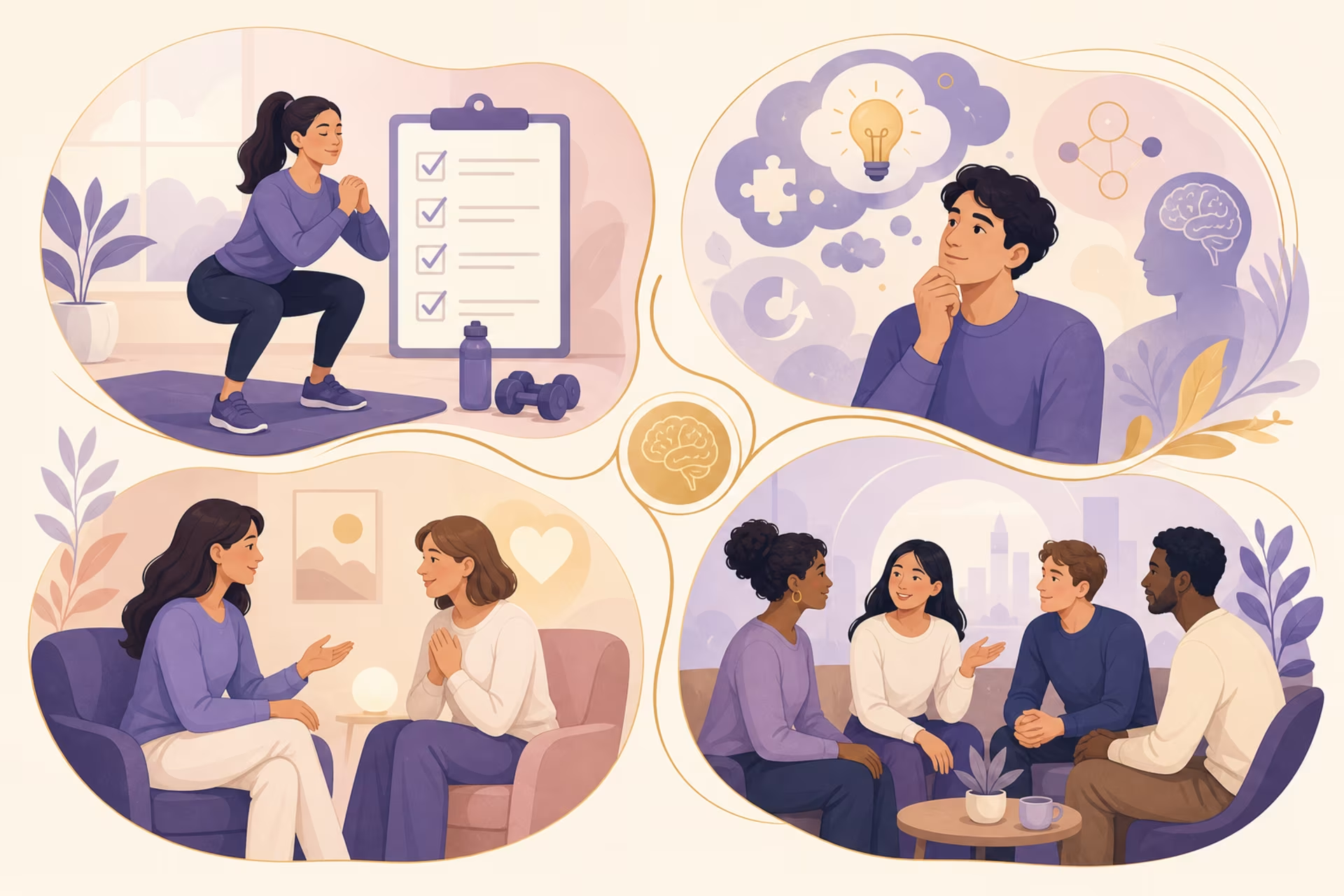
Different branches highlight different levers for change. Knowing which lens fits your problem saves time.
Behavioral Psychology Perspective
Behavioral psychology focuses on what is learned and reinforced, with a traditional emphasis on observable behaviors. Classical conditioning involves learning by association between two stimuli. Avoidance reduces anxiety short-term and strengthens it long-term. Praise, relief, attention, and convenience all shape habits.
Useful move: Make the desired behavior easier and the undesired behavior slightly harder. Put walking shoes by the door. Move social apps off the home screen.
Cognitive Psychology Perspective
Cognitive psychology examines attention, interpretation, memory, problem-solving, internal mental processes, and brain function. Cognitive psychologists study how these processes shape thinking, and neuroplasticity is the brain's ability to reorganize itself by forming new neural connections, which helps explain how learning can change the brain over time. Two people can receive the same feedback and hear either “I can improve” or “I am exposed.”
Useful move: When a thought feels true and urgent, write a balanced alternative that still takes the concern seriously, especially when cognitive abilities like attention or memory are under strain. You are not forced to choose between denial and catastrophe.
Humanistic Psychology Perspective
Humanistic psychology emphasizes meaning, growth, authenticity, and the conditions that help people flourish—empathy, congruence, and unconditional regard.
Useful move: Ask what value you want to move toward, not only what symptom you want to escape. Values give effort a direction.
Social Psychology Perspective
Social psychology studies social behavior, influence, norms, roles, and group dynamics. Social psychologists also examine group behavior to understand how context shapes everyday interactions. People underestimate how much context shapes behavior. A “difficult person” may be a person in a difficult system.
Useful move: Before personalizing someone’s behavior, consider incentives, fatigue, culture, and power. Then decide what boundary or request is still needed.
Subfields of Psychology
Psychology basics also include knowing who does what.
Clinical Psychology
Clinical psychology focuses on assessment, diagnosis, and treatment of mental illness, other mental disorders, and mental health conditions. Clinical psychologists use approaches such as cognitive behavioral therapy (CBT), schema-informed work, exposure methods, and other evidence-based therapies to help people manage mental health conditions and related difficulties. They typically do not prescribe medication, but they often collaborate with physicians and psychiatrists. Many clinical psychologists hold a doctoral degree and may work in hospitals, community clinics, or private practice.
Developmental Psychology
Developmental psychology studies human development across the lifespan: child development in early life, attachment in childhood, identity in adolescence, intimacy and work in adulthood, and meaning and loss later in life. Many adult patterns make more sense when viewed developmentally rather than as random character flaws. Developmental psychologists also examine how environmental factors shape growth and adaptation over time. trauma test can help you see whether old injuries are still in the mix.
Health Psychology
Health psychology examines links among behavior, stress, illness, and care. Sleep, movement, substance use, pain, and medical adherence all sit at this intersection. Mind and body are not separate operating systems.
Everyday Applications of Psychology Basics

This is usually what people wanted all along: psychology basics that change Tuesday afternoon.
Enhancing Communication Skills
Clear communication is less about clever phrasing and more about timing, ownership, and repair.
Lead with the observation, then the impact, then the request: “When plans change last-minute, I feel unsettled. Can we confirm by noon?”
Separate intention from impact. Both can be true.
During escalation, shorten your sentences. Long speeches rarely land in a flooded nervous system.
Repair early. “I got sharp earlier. I care about this and want to reset” prevents days of quiet damage.
Managing Stress
Stress physiology is faster than insight. Skills that change state often need to come before skills that change story.
Use a physiological sigh: two inhales through the nose, long exhale through the mouth, repeated a few times.
Name the stressor category: overload, uncertainty, conflict, or recovery debt. Different stressors need different responses.
Protect sleep like a clinical intervention. It is one.
Reduce decision fatigue. Automate breakfast, clothes, or evening shutdown so willpower is available for what matters.
Improving Learning and Education
Learning research is blunt: cramming feels productive and works poorly for durable memory.
Use retrieval practice. Close the notes and recall.
Space study sessions. Distributed practice beats marathon sessions.
Teach the idea to someone else, even briefly. Explanation reveals gaps.
Pair focus blocks with deliberate breaks. Attention is a resource, not a moral virtue.
Decision-Making Without Spiral
Psychology basics also help with everyday decisions that get hijacked by anxiety or perfectionism.
Separate reversible decisions from irreversible ones. Most daily choices are reversible; treat them that way.
Set a “good enough” threshold before you research. Endless information gathering is often anxiety management in disguise.
Ask what you would advise a friend with your values and constraints. Self-distance improves judgment.
Watch for all-or-nothing framing. “If it is not ideal, it is a failure” creates paralysis.
Boundaries Without the Scripted Speech
People often want a perfect boundary script. What they usually need is clarity about the limit and willingness to tolerate the other person’s reaction.
State the limit once, calmly, and specifically.
Expect pushback as information, not as proof you were wrong.
Follow through with behavior. A boundary without action becomes a preference.
Remember that guilt can show up even when the boundary is healthy—especially if an old schema equates self-protection with selfishness.
A One-Week Psychology Basics Practice Plan
If you want a concrete start, try this:
Day 1–2: Track one recurring trigger with the thought-feeling-urge-behavior chain.
Day 3: Write the schema story in one sentence (“If I disappoint people, I will be left”).
Day 4: Run one tiny behavior experiment that tests the story.
Day 5: Practice one repair conversation or one clear request.
Day 6: Do ten minutes of stress regulation before problem-solving.
Day 7: Review what changed, what did not, and what support you may need next.
A Short Story of How Psychology Basics Show Up in Real Life
Consider Maya, a high-performing professional who “knows better” and still spirals. A colleague takes longer than usual to reply. Maya’s chest tightens. She rereads her last message for tone. She drafts three follow-ups and deletes them. By evening she is convinced she has damaged the relationship. By morning she feels embarrassed by the intensity of her reaction.
Nothing in that sequence is random. A schema about rejection or defectiveness may have been activated. An anxious attachment pattern may have amplified the need for reassurance. Sleep debt and work stress may have lowered her threshold. Psychology basics do not erase the feeling. They give Maya a map: name the trigger, identify the story, regulate the body, then choose a proportionate next step—perhaps waiting, or sending one clear check-in, rather than a cascade of protest behaviors.
Or consider Jordan, who intellectualizes every conflict and then feels lonely. Jordan’s avoidant strategy reduces short-term discomfort and quietly starves connection. The useful intervention is not a lecture about vulnerability. It is a small behavioral experiment: stay in a hard conversation sixty seconds longer, name one feeling in plain language, and notice what actually happens.
These stories are ordinary. That is the point. Psychology basics earn their keep when they turn confusing intensity into understandable process.
Research Methods in Psychology
Psychology earns trust through scientific methods and psychological research, not vibes. Experiments test cause, and experimental psychology helped establish the field through controlled studies and systematic scientific investigation. Longitudinal studies track change over time. Clinical trials evaluate treatments. Qualitative work captures lived experience with depth.
For a non-researcher, the practical skill is media literacy. Ask: How big was the sample? Was there a comparison group? Is this correlation being sold as causation? Does the claim match the study design? Psychology basics include healthy skepticism, and psychological studies may involve different research subjects, including work on animal behavior in some areas of behavioral research.
Also notice the difference between a mechanism study and a treatment claim. A brain scan finding can be interesting without telling you what to do on Monday. A well-run therapy trial can guide care even if it does not explain every biological pathway. Matching the strength of the claim to the strength of the evidence is part of psychological literacy. Behaviorism dominated American psychology in the early 20th century, and after World War II, behavioral research and other approaches expanded in new directions.
Career Paths in Psychology
People drawn to psychology basics sometimes wonder about careers. Paths include clinical and counseling psychology, school psychology, industrial-organizational work, research, health psychology, forensic psychologists, and applied roles in product, policy, and education. Most clinical paths require graduate training and licensure. Many people never become psychologists and still use psychological literacy every day as parents, managers, partners, and clinicians-in-adjacent-fields.
If you are exploring the field, start with what kind of problem you want to help solve: suffering, learning, teams, public health, research design, or challenges within the criminal justice system. The day-to-day work differs more than the undergraduate major suggests, and psychologists work in settings ranging from universities and schools to hospitals and private practice.
The Future of Psychology
Contemporary psychology is moving toward more precise, personalized, and integrated care: better measurement, stronger evidence for what works for whom, attention to culture and context, and collaboration across neuroscience, medicine, and technology. Digital tools can support tracking and access, but they do not replace the relational conditions that help people change—safety, clarity, accountability, and practice.
The constant is human. Tools change. The need to understand mind, behavior, and relationship does not.
For readers, the future-facing skill is discernment: use new tools when they improve measurement or access, and keep returning to fundamentals—accurate description, workable explanations, and experiments you can actually run in your life. Stronger psychological knowledge should continue to improve well being in everyday settings as well as care settings.
Effective Clinical Psychology Services at Bay Area CBT Center
At Bay Area CBT Center, clients can access in-person and online psychological services in California, with evidence-based care for individuals, couples, and families. People seeking psychologists in San Francisco, a psychologist in San Diego, a psychologist in Los Angeles, or a psychologist in Oakland can find specialized support matched to their needs.
Services include individual therapy, couples counseling, family therapy, group therapy, and customized mental health retreats. Clinicians help with anxiety, depression, trauma, relationship patterns, and the deeper schema and attachment processes that keep those struggles in place.
A psychologist helps by examining the psychological processes underneath thoughts, behaviors, and emotions—and by translating that understanding into change you can practice in real life.
Summary
Psychology basics are not trivia about famous theorists. They are a practical language for understanding the human experience—why you think, feel, and act as you do, and how those patterns can change. Start with description. Look for schemas and loops. Match tools to the level of the problem. Use communication, stress regulation, and learning methods that respect how minds actually work. And when a pattern is bigger than self-help, skilled clinical support can help you work at the right depth.
Curiosity is already a useful first step. What you do with it—naming patterns, testing them, and practicing small changes—is where psychology basics start to matter, helping human beings respond with more clarity and flexibility in everyday life.
If you want a next step, take our therapy matching quiz or relationship schema quiz, browse activities and mental health exercises, or try our guided meditations and mindfulness practices.
Along with therapy, Bay Area CBT Center offers mental health quizzes you can take on your own.
Frequently Asked Questions (FAQs) about Psychology Basics: A Beginner's Guide to Understanding the Mind
Psychology is the scientific study of the mind and behavior. It explores mental processes such as cognition, emotion, motivation, and personality as well as observable behaviors in humans and animals.
Human psychological traits refer to consistent patterns in thoughts, feelings, and behaviors that distinguish individuals. These traits help psychologists explore personality psychology and understand individual differences.
University psychology departments conduct research, teach foundational and advanced concepts, and train future psychologists. They play a critical role in expanding knowledge in cognitive science, clinical psychology, and other subfields.
Major branches include clinical psychology, developmental psychology (including child psychology), cognitive psychology, social psychology, health psychology, and animal psychology.
Early psychology laid the groundwork for modern scientific methods in the study of the mind. Pioneers like Wilhelm Wundt and William James helped establish psychology as a distinct scientific discipline.
Psychologists study mental representations to understand how people perceive, store, and manipulate information in the mind, which is central to cognitive psychology.
Forensic psychology applies psychological principles to assess and understand criminal behavior, aiding in legal decisions and rehabilitation.
Freudian psychology, or psychoanalytic theory, emphasizes the unconscious mind, early childhood experiences, and inner conflicts as drivers of behavior.
Psychology examines fear responses through behavioral and cognitive perspectives, exploring conditioning, brain mechanisms, and emotional regulation.
The most basic components include cognition, emotion, behavior, personality, and social influences. These elements form the foundation for studying human psychological traits and mental health.