Books by Dr. Avigail Lev
The books behind
our approach
Three books, one method. Published by New Harbinger, translated into Spanish and German, cited in more than 230 academic works. They are where the way Bay Area CBT Center treats people began.
3books with New Harbinger, 2012–2017
2translations: Spanish and German
230+citations on Google Scholar
2randomized controlled trials behind the method
Why these books exist
Most therapy treats the symptom. These books go underneath it.
The argument you keep having. The anxiety before every text. The pattern of leaving before you can be left. These are symptoms. Underneath them are schemas: the core beliefs you formed in childhood about yourself and other people. “I'm not enough.” “People leave.” “My needs don't matter.”
Schemas are the smallest building block. Combine them with the ways you learned to cope and you get an attachment style. Add more layers and you get personality patterns, and eventually diagnoses. Two people with the same diagnosis are usually running on different schemas, which is why the work starts at the schema and not at the label.
When a schema gets triggered, it produces four kinds of reaction at once: automatic thoughts, feelings, sensations in the body, and urges to do something about it. If you act on the urges, you usually create the very outcome the schema predicted. The belief gets confirmed, and the cycle runs again.
The cycle
How a schema keeps itself alive
The same formulation for every schema
This is why the method works across the board. Whatever the schema is, the shape of the cycle is identical: belief, reaction, coping behavior, outcome that proves the belief right. Every coping behavior we learn in service of a schema ends up confirming it. A self-fulfilling prophecy, running on repeat.
Take an abandonment schema. The belief is “people leave.” When it's triggered, the thoughts are “they're pulling away,” “they've lost interest,” “I'm too much”; the feelings are panic, dread, loneliness; the body tightens and the stomach drops; and the urges are to hold on, check, get reassurance. So the person seeks reassurance over and over, clings, checks, accuses. The partner feels suffocated and pulls back. The belief is confirmed: people leave.
Take a defectiveness schema. The belief is “if anyone really knew me, they couldn't love me.” When it's triggered, the thoughts are “don't let them see,” “they'd be disgusted,” “I'm a fraud”; the feelings are shame, fear, sadness; the body wants to shrink and the face burns; and the urges are to hide, to please, to disappear. So the person tells people what they want to hear, edits themselves, shows a false self. Nobody ever meets the real person, so nobody can love the real person. The belief is confirmed: no one could love me as I am.
Different beliefs, different behaviors, same machine. That's what makes one formulation enough for every client: find the schema, trace the four reactions, name the coping behavior, show how the outcome feeds the belief. Then work on each piece with the tool that fits it, and replace the coping behavior with an action that moves toward what the person actually wants.
The questionnaire
Why the schema quiz is so accurate
The schema questionnaire used on this site is the same instrument used in the research behind the books. It has now been completed by more than 40,000 people through the site's quizzes. Business Insider wrote about it in 2024: A couples therapist says she can predict your relationship problems with a 30-question quiz.
It is accurate for a simple reason. It doesn't try to measure something invisible: a personality type, a character trait, a diagnosis. It measures what you believe about yourself and other people. People know what they believe, even when they've never said it out loud, so the answers are honest and the results hold up.
“I've read tens of thousands of these results. From a person's schema profile I can usually predict how they cope, what they do when they feel threatened, and where their relationships get stuck. When two partners send me their results, I can predict most of what's going to happen between them before they tell me a single story. That isn't magic. The quiz is measuring the beliefs that drive the behavior, so the behavior follows.”
Dr. Avigail Lev, PsyD
The treatment
Values replace the schema
Treatment turns the cycle around. Instead of a schema at the top driving the behavior, a value sits at the top: the thing the person actually wants to move toward. The same difficult thoughts, feelings, sensations, and urges still show up, but now they are understood as barriers between the person and the action that matters. The value is the motivation for changing the behavior. The barriers are where the interventions go. When a barrier comes up, we work on it with the tool that fits it, and then the person takes the values-based action anyway.
The belief itself changes last, and it changes because of the actions. Each values-based action produces an outcome the schema didn't predict: the person asks directly and isn't abandoned, shows the real self and isn't rejected. Those are emotionally restorative experiences, and each one disconfirms the core belief a little. One doesn't do it. When the person has changed the behavior enough times, and collected enough of those moments, then and only then does the belief shift. That is why the work starts with values and action rather than with arguing the belief out of existence.
What we do at each barrier
Every intervention below is used in the books and in the room. Which one we reach for depends on which barrier is in the way.
What these books add
A map for finding the pain and knowing what to do about it
Acceptance and Commitment Therapy rests on a distinction between two kinds of pain. Primary pain is the pain that can't be avoided: the grief, fear, or loneliness that comes with being a person who wants things and loses things. Secondary pain is what avoiding primary pain produces: the withdrawal, the fight, the numbing, the years spent organized around not feeling something. ACT's job is to help people make contact with primary pain so they can stop paying the cost of avoiding it.
What ACT does not hand the clinician is a method for finding the primary pain in the person in front of them. That is what schemas add. A schema names the specific pain and predicts the thoughts, feelings, sensations, and urges it will produce when triggered. With the schema identified, the clinician has a map: here is the primary pain, here is what this person does to avoid it, here is where each intervention belongs. Is the barrier a thought? A feeling? A sensation? An urge? The formulation says which, and therefore what to do and when.
Because schemas sit underneath every diagnosis rather than belonging to any one of them, the map is transdiagnostic. The same formulation works for OCD, for panic, for depression, for a couple who can't stop having the same fight, for a manager who can't delegate. Different presentations, same building blocks, same method.
The other half of the map comes from ACT's values work. The clinician never has to decide which behaviors are right. Values give the person their own direction and their own reason to move, and they define what the alternative to the coping behavior actually is. Not “stop withdrawing,” but “move toward the closeness you want.” Intrinsic motivation and a concrete target, without anyone imposing either.
That is what these books contribute: a clear way to formulate any problem, where the primary pain is, what the avoidance looks like, which piece to work on, and which direction to move, that applies across the whole range of what walks through a therapist's door. Two randomized controlled trials tested it: the group protocol behind the first book, and the couples protocol behind the third. The three books developed it for clinicians, for readers, and for couples. The method is called SchemACT, and every clinician at Bay Area CBT Center is trained in it.
“A formulation does for therapy what values do for a life: it tells you where you are and which way to go.”
Dr. Avigail Lev, PsyD · founder, Bay Area CBT Center
The books
Three books, three audiences, one method
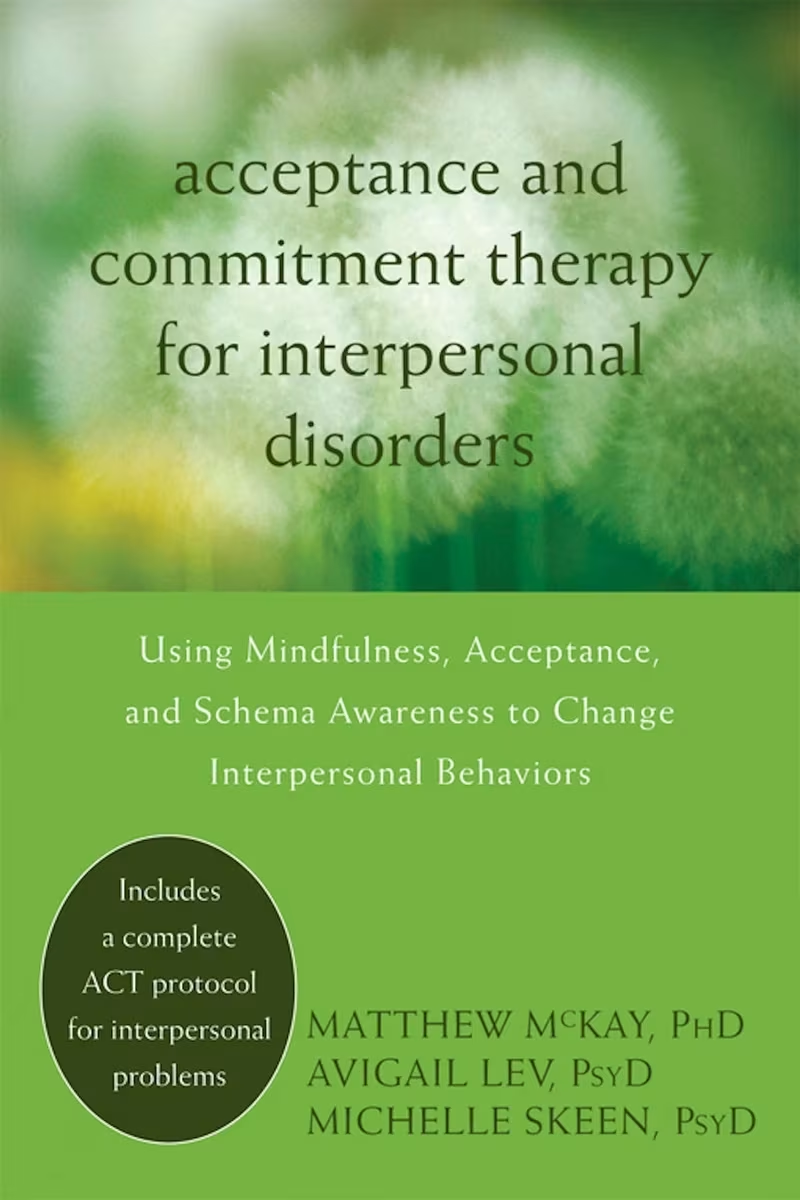
Acceptance and Commitment Therapy for Interpersonal Problems
The clinician's guide. It identifies the ten interpersonal schemas most often behind chronic relationship difficulty, maps the coping behaviors each one drives, and lays out a session-by-session ACT protocol for working with them. The protocol was tested in Dr. Lev's doctoral research before it was published. This is the book that first put the method in clinicians' hands, and it is what the practice does every day.
German edition: ACT und Schematherapie (G.P. Probst Verlag, 2013) · Amazon · Publisher
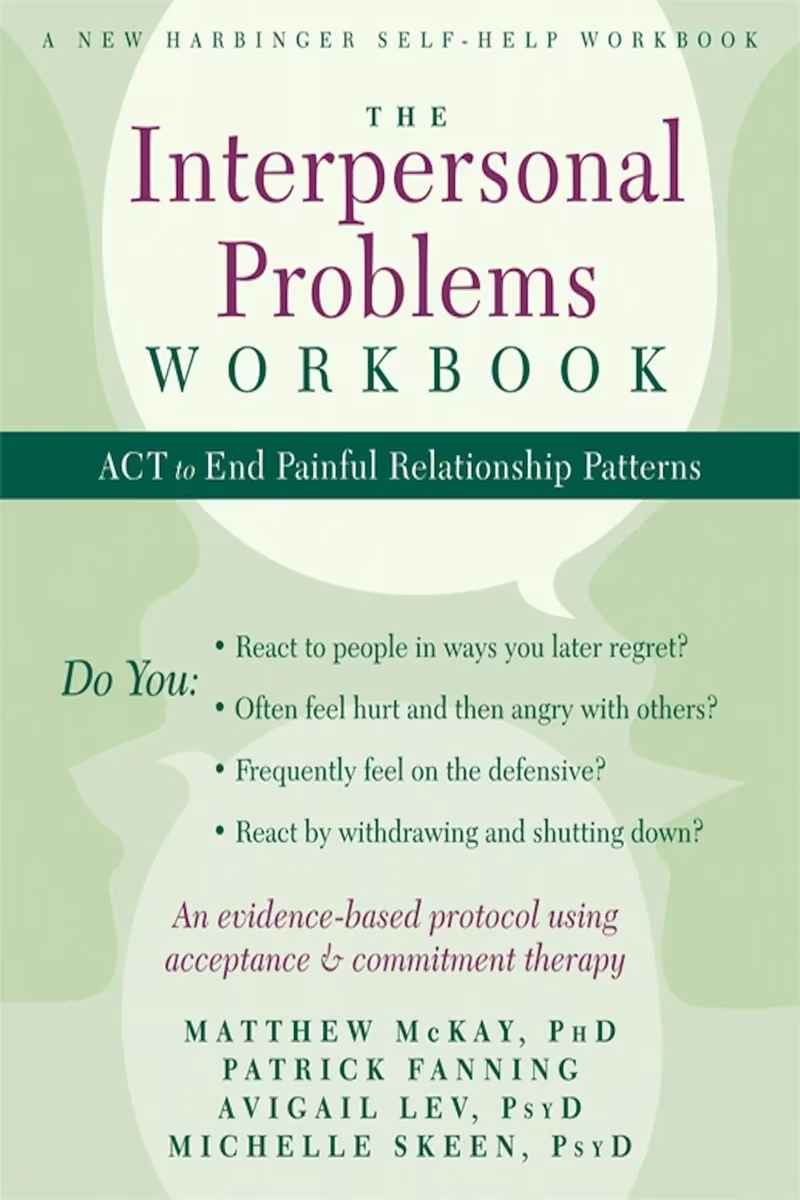
The Interpersonal Problems Workbook
The same method written for readers rather than clinicians. Do you react to people in ways you later regret, feel hurt and then angry, go on the defensive, or shut down? The workbook helps you identify your own schemas, see the pattern as it happens, and practice choosing a values-based response in the moments that used to run on autopilot.
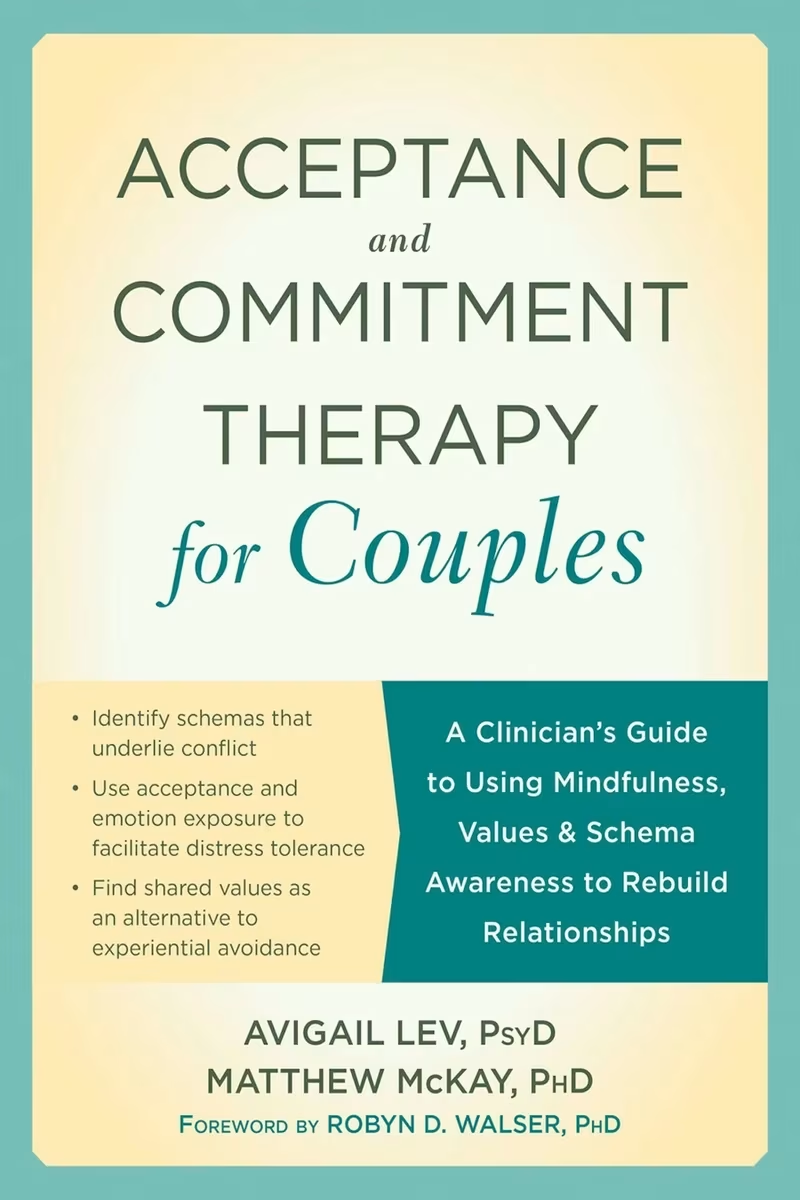
Acceptance and Commitment Therapy for Couples
The method applied to two people at once. Each partner brings schemas; conflict is what happens when they trigger each other. The book teaches clinicians to help couples identify the schemas underneath their recurring fights, use acceptance and emotion exposure to tolerate the distress those fights produce, and find the shared values that make the relationship worth the work. It is the basis for couples therapy at Bay Area CBT Center.
Spanish edition: Terapia de aceptación y compromiso para parejas (Desclée De Brouwer, 2018) · Amazon · Publisher
Research
The studies behind the books
Two randomized controlled trials and a conference presentation. The trials are being prepared for journal publication.
- Randomized controlled trial 1 — the group protocol. Doctoral dissertation, The Wright Institute, 2011: A New Group Therapy Protocol Combining ACT and Schema Therapy in the Treatment of Interpersonal Disorders. Tested the group protocol that became the first book.
- Randomized controlled trial 2 — couples. Elizabeth Kusin's doctoral dissertation, chaired by Dr. Lev, The Wright Institute, 2018: An Evaluation of Acceptance and Commitment Therapy for Couples in a Workshop Setting. Forty-five couples were randomly assigned to a four-day ACT couples workshop based on the third book, a four-day Emotionally Focused Therapy workshop, or a waitlist. The ACT workshop produced significant gains in relationship satisfaction and communication, and was the only condition that significantly increased how often partners noticed each other's positive behaviors.
- Couples Schemas, Cognitive Fusion, and Interactions in the Relationship. Poster, ACBS Virtual World Conference, 2021. With Lidia Baran, Joanna Dudek, Jadwiga Jagódka, Magdalena Krasińska, Marta Potuczko, Agata Serwaczak, and Kamil Zając. Read the poster.
- Citations. The books have been cited more than 230 times in the academic literature. See the citing work on Google Scholar.
From the books to the room
Every therapist at Bay Area CBT Center works from this method. The quizzes on this site identify your schemas; a consultation matches you with a clinician trained in the approach.
Clinicians: Dr. Lev offers consultation and CE training in the method.
Common questions
Frequently asked questions
Do I need to read the books before starting therapy?
No. The books are for clinicians and for people who like to understand the method. Your therapist will use the approach with you whether or not you've read them.
Which book should I start with?
If you're a reader, The Interpersonal Problems Workbook. If you're a clinician, Acceptance and Commitment Therapy for Interpersonal Problems. If your struggle is a relationship, the couples book, though it is written for therapists.
What is a schema?
A core belief about yourself or other people, formed early in life, that acts as a lens. “I'm not enough,” “people leave,” “my needs don't matter.” Schemas feel like facts. They are patterns, and patterns can change.
What does “transdiagnostic” mean?
The same method works across diagnoses. Instead of a different treatment for OCD, panic, depression, and relationship problems, the method works at the schema underneath each of them.
What is SchemACT?
The method Dr. Lev developed across these three books: Schema Therapy's map of core beliefs combined with Acceptance and Commitment Therapy's tools for stepping out of the cycle, with interventions from CBT, DBT, compassion-focused, and somatic therapy applied to whichever piece of the cycle needs them.
Is the method evidence-based?
The method has been tested in two randomized controlled trials, one on the group protocol and one on the couples protocol. Both parent approaches, Schema Therapy and ACT, have large evidence bases of their own. The books have been cited more than 230 times in the academic literature.