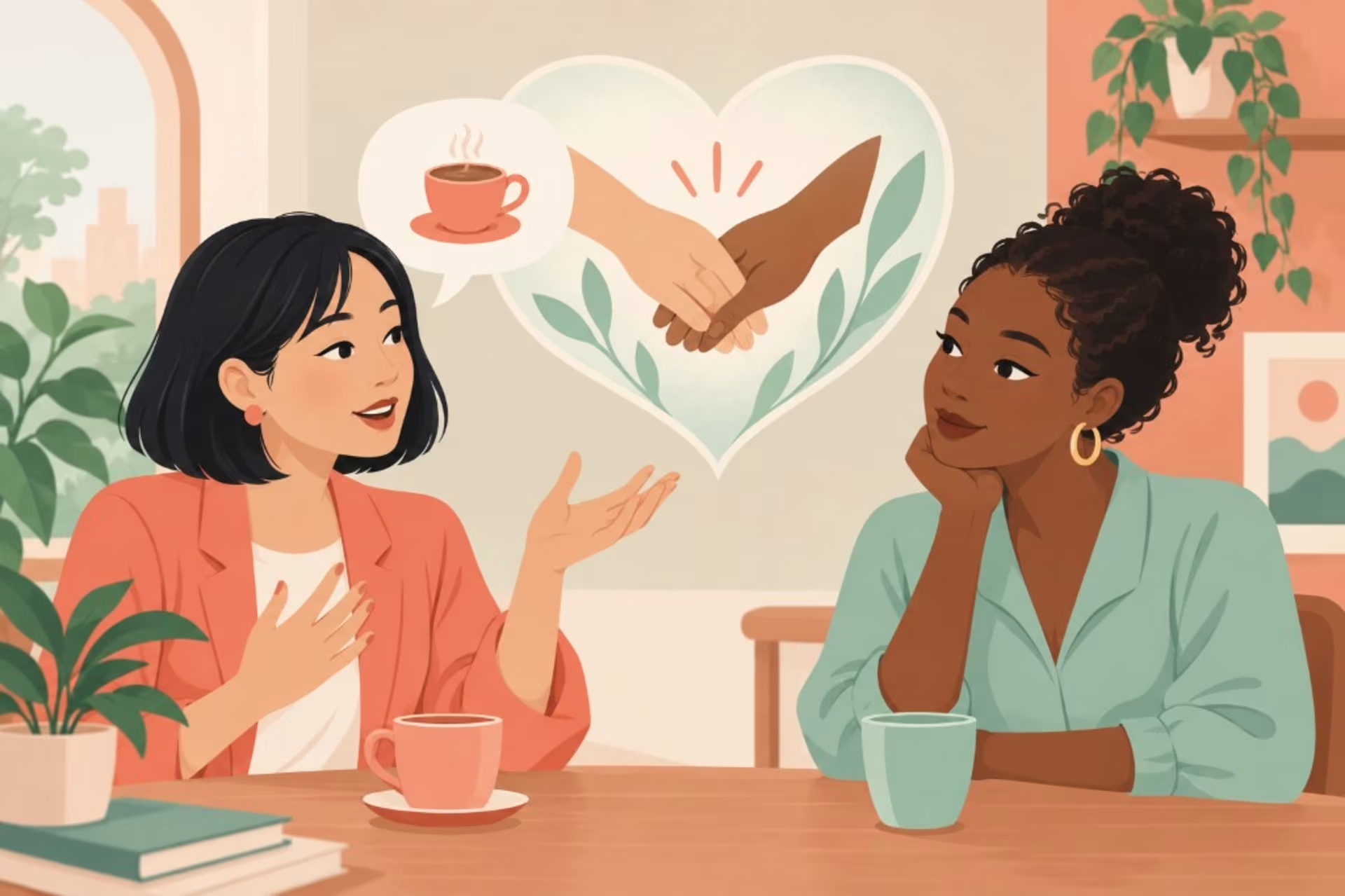
Conflict Resolution: A Practical Guide to Resolving Conflicts with Emotional Intelligence

Conflict resolution is one of the most important skills you will ever develop, and almost nobody teaches it to you. This guide walks you through the exact tools we use at Bay Area CBT Center to help couples and families resolve disagreements, repair ruptures, and build relationships that can hold difficult conversations without falling apart. Every framework here is something you can start practicing today.
Key Takeaways
Resolving conflict is a learnable life skill that matters more for the quality of your personal relationships than most things taught in school. Most adults begin learning conflict resolution skills in their 30s, 40s, or 50s, after years of painful patterns that didn't have to go that way.
Effective conflict management depends on emotional intelligence, emotional awareness, perspective taking, and the ability to separate needs from wants during the conflict resolution process.
Nonviolent Communication (NVC) and Acceptance and Commitment Therapy (ACT) are the main frameworks used at Bay Area CBT Center for resolving conflicts in couples and families in San Francisco, Los Angeles, and San Diego.
This article covers concrete tools: naming feelings and needs, warm vs. cold empathy, recognizing self serving fairness interpretations and cognitive distortions, using the NVC formula, the difference between requests and demands, and a step-by-step negotiation formula used in our couples therapy.
You can practice these skills at home using our mental health exercises, and Bay Area CBT Center also runs a Nonviolent Communication group and mental health retreats focused on conflict resolution skills.
Why Conflict Resolution Matters More Than Calculus
You spent years in school learning algebra, calculus, and the periodic table. You probably never had a single class on how to name what you feel, identify what you need, or negotiate a disagreement without someone ending up hurt. These are the skills that determine the quality of your relationship with your partner, your kids, your parents, and your closest friends. Conflict resolution skills boost well-being and productivity in every area of life, yet most of us have to reverse-engineer them as adults.
Consider a couple arguing every Sunday about chores. One partner feels resentful because the house is always messy. The other feels criticized no matter what they do. Without conflict resolution skills, this fight repeats for years, eroding trust and intimacy. Effective conflict resolution reduces emotional and financial costs; it also strengthens relationships and builds trust when both people feel heard. The difference between resolving conflicts (aiming for repair and mutual understanding) and just stopping an argument (shutting down, avoiding, or winning at the other person's expense) is enormous.
Many people in their 30s, 40s, and 50s arrive at therapy saying, "We never learned how to fight fair." That is a normal part of adult life, and the good news is that these are trainable skills. Conflict resolution is not a personality trait. It is a set of practices you can learn at any age.
What Is Conflict? From Arguments to Unmet Needs
Conflict is a perceived incompatibility of needs, goals, or values between two or more parties who matter to each other. It shows up when your partner is chronically late and you feel disrespected, when your teenager wants more independence and you need to know they are safe, or when siblings disagree about how to care for aging parents. Interpersonal conflict is not a sign that something is broken. It is a normal part of every close relationship. The issue is never whether conflict happens; it is how the parties involved handle conflict when it does.
Mismanaged conflict can cause irreparable rifts in relationships. When a dispute goes unaddressed, minor frustrations become major disputes. Addressing conflict early can prevent that spiral. Imagine a partner who feels hurt each time the other scrolls their phone during dinner. If that hurt is never named, it grows into resentment, then contempt, then emotional withdrawal. But when conflict is managed well, it actually deepens intimacy because both people learn more about each other's underlying interests and needs.
Strong emotions in conflict, whether rage, hurt, or shutdown, usually signal deeper unmet needs: respect, closeness, autonomy, security, or rest. Conflict resolution includes negotiation, mediation, and arbitration methods depending on the context, but in personal relationships, the goal is almost always the same: find a mutually acceptable solution where neither person feels dismissed. The couples who stay together are not the couples who avoid conflict. They are the ones who keep returning to the resolution process with willingness and care.
How Do You Usually Respond to Conflict?
Before learning new tools, it helps to recognize your default. Think about your last three arguments. When things got heated, did you attack ("You always…"), defend ("That's not what I meant!"), fix ("Here's what you should do"), shut down and stonewall, or immediately placate and agree to anything just to end the tension?
The Thomas-Kilmann model identifies five conflict management styles: avoiding, accommodating, competing, compromising, and collaborating. Conflict management styles include avoiding, accommodating, and competing, but collaboration is a preferred conflict management style for win-win solutions. Compromising is effective when goals are moderately important, but for the issues that matter most, you want to build toward collaboration. Most people default to one or two styles without realizing it.
These patterns are often shaped by your family of origin. If you grew up in a home where anger was explosive, you may have learned to avoid conflict at all costs. If nobody in your family ever talked about hard topics, you may not have the language for what you feel. At Bay Area CBT Center, we help clients map their typical emotional reactions and behavioral patterns across recent conflicts so they can see the habit clearly before we introduce new conflict resolution skills. Awareness is always the first step.
Emotional Intelligence and Emotional Awareness in Conflict

Emotional intelligence in the context of conflict resolution means three things: recognizing what you feel, understanding what you are needing underneath that feeling, and being able to imagine what the other person might be feeling and needing. A meta-analysis of 37 studies found that emotional intelligence correlates with better conflict outcomes overall (r = .209), with the effect being even stronger for relational outcomes (r = .262) than for economic ones. In personal relationships, that relational quality is exactly what matters.
Emotional awareness is crucial for effective conflict communication. It starts with noticing sensations in the body: a tight jaw, a racing heart, a knot in the stomach. Then it moves to labeling emotions accurately. There is a big difference between hurt, anger, and shame, and each one points to a different need. Emotional awareness helps assess your emotional experience before you speak. Understanding emotions improves communication during conflicts, and emotional awareness can prevent unhealthy conflict responses like lashing out or going silent. If you struggle to name what you feel, tools like the feeling wheel can help you build vocabulary.
Here is the difference in practice. Reactive version: "You never listen, you're so selfish." Emotionally aware version: "When you checked your phone during dinner, I felt invisible and hurt because I need attention and connection after work." The content is the same. The landing is completely different. Emotional awareness is crucial for effective conflict management, and it sets the foundation for everything that follows.
Warm vs. Cold Empathy: Balancing Feeling and Understanding
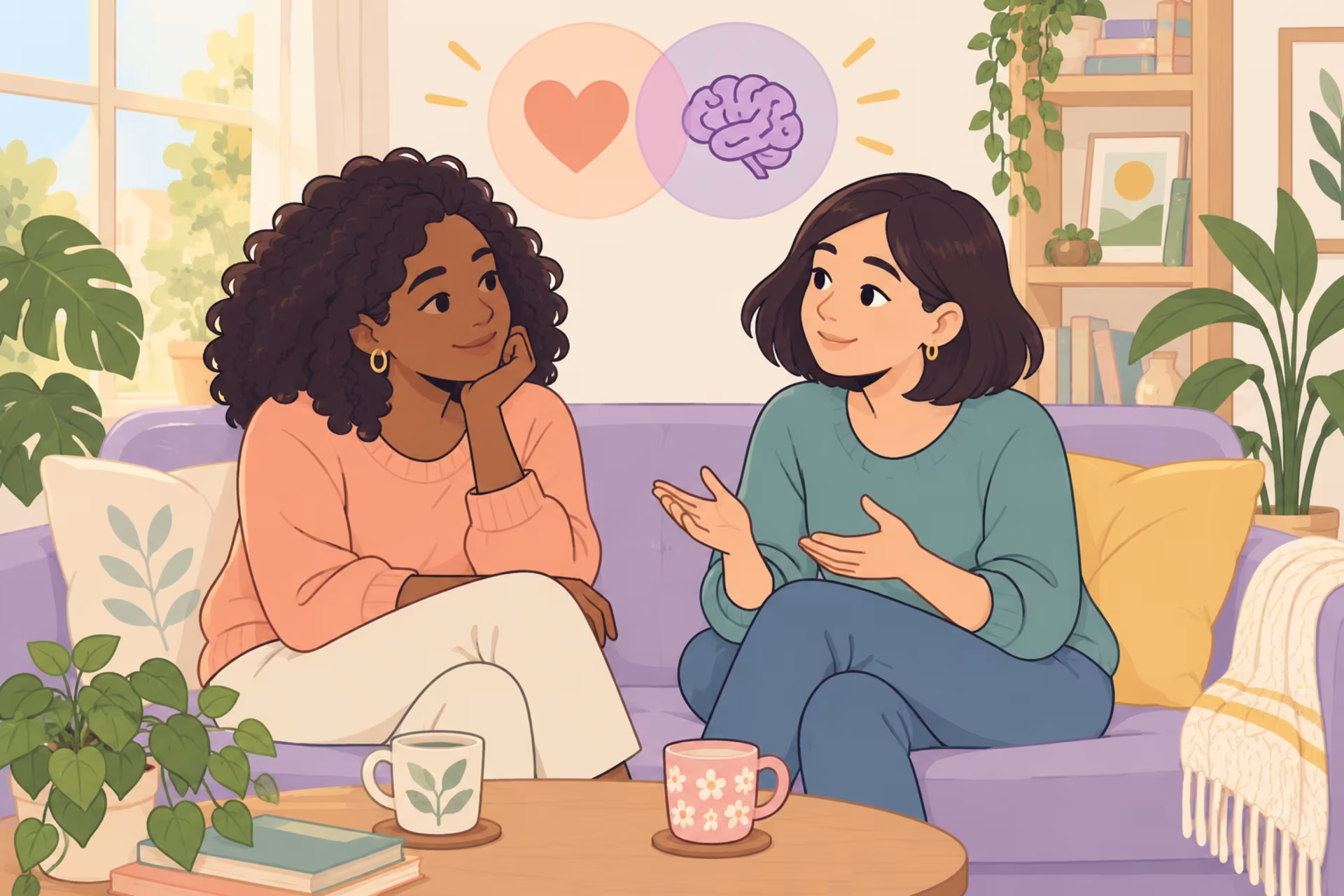
Empathy and validation in conflict acknowledge the other person's feelings as valid. But empathy is not one thing. Warm empathy is feeling with someone: emotional resonance where you can almost feel their sadness, fear, or joy in your own body. When your partner tears up describing a painful memory and your eyes fill too, that is warm empathy.
Mid-argument, many partners feel ambivalence—wanting to repair while still protecting a wounded pride.
Cold empathy is cognitive perspective taking. You accurately understand what the other person feels and why it makes sense given their history, without necessarily feeling it yourself. For example: "It makes sense you're scared of abandonment given what happened in your last relationship." You are taking the other's perspective and seeing their other's point of view clearly.
Resolving conflicts requires both. Too much warm empathy and you get emotionally flooded, lose yourself in the other person's pain, and agree to things you later resent. Too much cold empathy and you come across as detached, like a clinician analyzing a case rather than a partner who cares. One partner in a couple might default to warm empathy, saying yes to everything in the moment, then feeling resentful for weeks. Another partner might stay entirely in cold empathy, offering perfectly logical reflections while the other feels completely alone. The skill is noticing which side you default to and intentionally dialing up the other when the moment calls for it.
Skillful empathy in conflict means you can feel with someone and still keep a clear self—neither flooded nor coldly detached.
ACT and CBT Tools for Staying Grounded During Conflict
At Bay Area CBT Center, we integrate Acceptance and Commitment Therapy and Cognitive Behavioral Therapy into conflict management work with couples and families. These frameworks give people practical ways to stay grounded when emotions escalate. Managing emotions before attempting to resolve conflict helps prevent escalation, and emotional regulation helps prevent volatility during conflicts.
ACT skills for the resolution process include mindfulness of the present moment (noticing body sensations and urges before reacting), defusion from thoughts like "She doesn't care about me" (seeing them as mental events rather than facts), and using core values like kindness and honesty to guide your behavior instead of letting the emotion decide.
CBT contributes by helping you identify automatic thoughts and cognitive distortions: mind reading ("He's doing this to hurt me"), catastrophizing ("This fight means we'll break up"), emotional reasoning ("I feel rejected, so you must be rejecting me"), and self serving fairness interpretations ("It's only fair if I get my way"). These distortions warp how we read our own emotional responses and the other party's intentions.
Here is a concrete example. During a Sunday morning argument about money, one partner notices the thought "You never respect my hard work." Instead of attacking, they pause, recognize this might be mind reading, use defusion, and choose to say: "I'm feeling unappreciated and scared about our finances. Can we talk about this?" That small shift changes the entire trajectory of the conversation.
Reading and Using Body Language in Conflict
Emotional awareness extends beyond words. Nonverbal cues can reveal true feelings during conflicts: crossed arms, averted gaze, clenched jaw, a flat tone, or a partner who says "I'm fine" while staring at the floor. Body language often communicates more than the words themselves.
In a household, this shows up constantly. A teen rolling their eyes and turning away during a conversation about curfew. A partner's shoulders rising toward their ears at the dinner table when finances come up. These signals are data. The skill is naming what you see without judgment: "I notice your shoulders are tight and you're looking away. I'm guessing you might feel hurt or annoyed?" This is far more effective than interpreting it as "You're being childish" or "Stop giving me attitude."
Matching words and body language builds trust. When someone says "I'm listening" but keeps checking their phone, the conflict resolution process breaks down. Active listening strengthens mutual understanding during conflicts, and it requires your full physical and verbal presence.
Nonviolent Communication (NVC): The Core Conflict Resolution Process
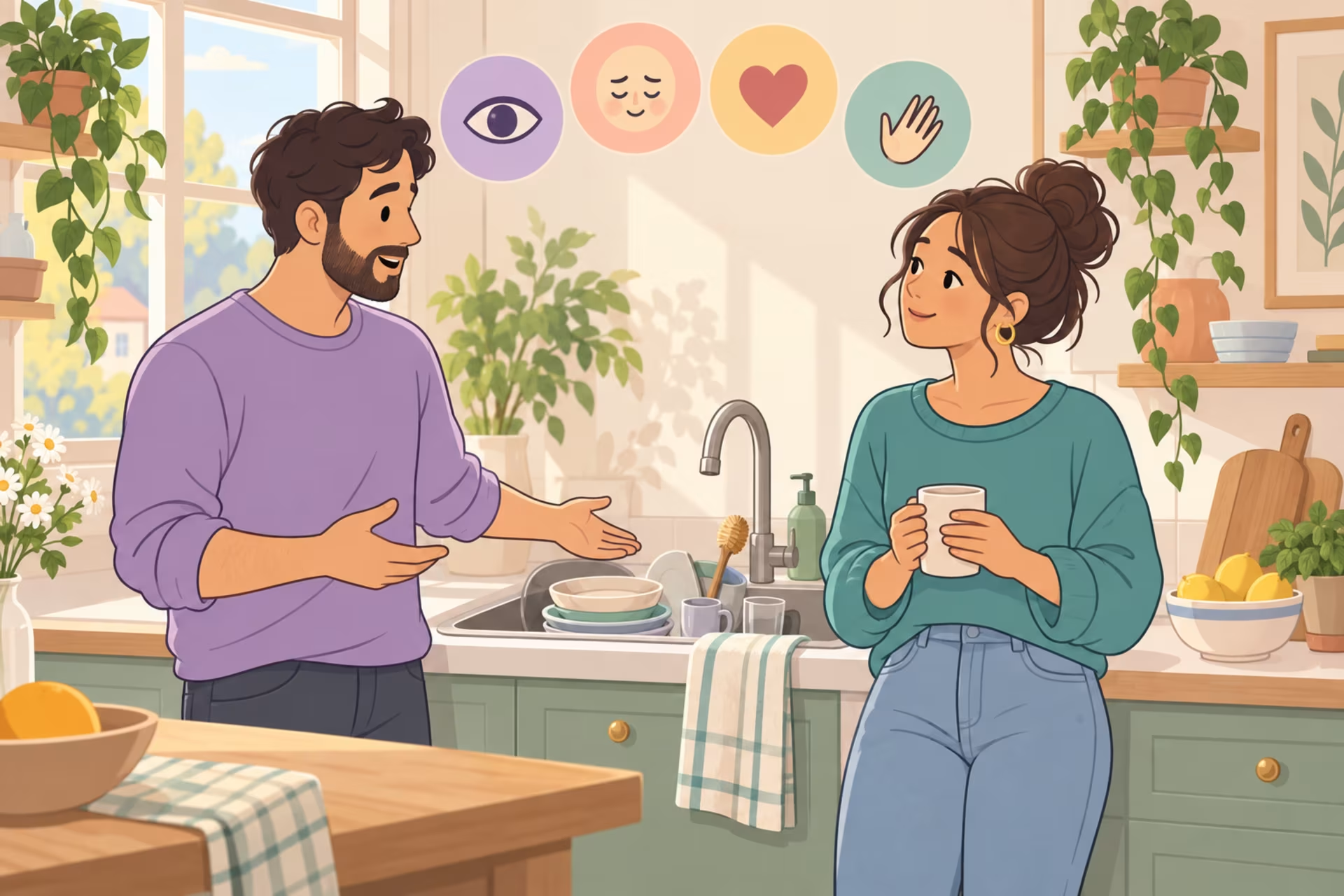
Nonviolent Communication is the primary framework we use in couples therapy and groups at Bay Area CBT Center in San Francisco, Los Angeles, and San Diego. Developed by Marshall Rosenberg, NVC provides a repeatable conflict resolution process built on four steps:
Observation: What happened, without judgment or evaluation.
Feeling: How you feel about what happened.
Need: What you are needing underneath that feeling.
Request: A specific, doable ask for right now.
Here is the same message said two ways. Blame version: "You're so lazy! You never help with chores. I'm done." NVC version: "I noticed there are dishes in the sink from last night. I feel tired and overwhelmed. I need support with cleaning up. Would you be willing to handle the dishes tonight?" Using neutral and constructive language can reduce defensiveness during discussions. Using 'I' statements prevents blaming in conflicts. The content is identical; the outcome is not.
NVC also works for listening. Instead of debating the facts, you silently guess the other person's feelings and needs: "I'm guessing you're feeling overwhelmed and need more support with the kids?" This is active listening in practice, and active listening is essential for effective conflict resolution. Separating the person from the problem enables more constructive conflict resolution because you are addressing what is happening, not who is wrong.
We run an NVC workshop and mental health retreats where clients spend entire weekends practicing observation, feeling, need, and request in real-time relationship conflicts.
Needs vs. Wants: The Rule of Staying Rigid with Needs and Flexible with Wants

A need is broad and universal: affection, rest, autonomy, play, safety, understanding. A want is a specific strategy to meet that need: a hug, a nap, a walk alone, a movie night. People get stuck in conflict because they fight for a specific want instead of staying connected to the underlying need. Focusing on interests rather than positions helps identify underlying needs during conflict.
The rule is simple: be flexible with what you want and rigid with what you need. The more flexible you are about what you want, the more likely you are to get what you need.
Here is what this looks like in practice:
"I feel lonely. I need affection. Would you be willing to give me a hug?" "No, I'm not in a hugging mood." "I need affection. Would you be willing to give me a kiss?" "No." "Would you be willing to rub my back?" "No." "Would you be willing to play thumb wars?" "Would you be willing to rub my hair?" "Would you be willing to dance with me?" "Would you be willing to wrestle?"
The need for affection stays constant. The wants keep changing until one lands.
Second example with rest:
"I feel exhausted. I need rest. Would you be willing to take the kids Saturday morning?" "I can't, I have a meeting." "I need rest. Would you be willing to handle dinner tonight so I can lie down?" "No, I'm wiped out too." "I need rest. Would you be willing to take a walk with me so I can decompress?" "Yeah, I can do that."
Healthy conflict resolution leads to creative problem solving. Recognizing conflicting needs fosters creative problem solving because both partners keep offering new ideas rather than escalating over who is right. This is how finding solutions becomes collaborative rather than adversarial.
Requests vs. Demands: How to Ask Without Punishing "No"

A true request gives the other person the freedom to say no. A demand is framed as a request, but no is punished with guilt, blame, withdrawal, or threats. You usually do not know whether your ask was a request or a demand until you hear no and see how you respond.
Here is the difference:
Request version: "Would you be willing to handle bedtime tonight? I need rest." "No, I'm really tired too." "Okay. I still need rest. Would you be willing to do the dishes so I can lie down while the kids play?"
Demand version: "Would you be willing to handle bedtime tonight?" "No, I'm really tired too." "Seriously? I would never say no to you. You always put yourself first. Fine, I'll just do everything myself."
If the response to no is guilt tripping, assigning blame, attacking, or scorekeeping, then it was never a request. In couples therapy at Bay Area CBT Center, we often rehearse hearing "no" in session so both parties can practice tolerating disappointment, staying in emotional awareness, and continuing the resolution process creatively instead of escalating.
The Bay Area CBT Center Negotiation Formula for Couples

When simple NVC requests are not enough and a couple is stuck in a loop around the same issue month after month, we use a four-step negotiation formula. This process works for recurring disputes about vacations, money, chores, parenting, intimacy, or how weekends are spent.
The formula assumes that in a healthy relationship, nobody gets their pure ideal. Instead, both involved parties move toward close-enough solutions while ensuring neither ends up in an intolerable situation. The interest-based relational approach focuses on mutual concerns, not on winning. This negotiation formula is part of the conflict resolution process we teach in therapy, executive coaching for leaders in California, and in our mental health retreats.
Step 1: Choose Your Values Before You Negotiate
Before discussing specifics, each partner separately chooses five values they want to embody during the negotiation. For example: kind, present, respectful, assertive, and honest. These values act as a compass throughout the process.
One partner in a San Francisco couple might choose curiosity, calm, honesty, collaboration, and playfulness. The other chooses self-respect, courage, patience, empathy, and clarity. When emotions rise, either person can pause and ask: "Is what I'm about to say aligned with 'respectful and honest,' or is it more aligned with 'winning'?"
We often have couples write these values on a notepad on the coffee table or in a shared document during telehealth sessions so they remain visible throughout the conflict resolution process. The values don't prevent disagreements. They shape how the conflicting parties move through them.
Step 2: Write Your Ideal and Your Intolerable
Each person privately writes down two things: their ideal (very specific, "if I could have it exactly my way") and their intolerable (general conditions they cannot live with long term). These must not be identical.
Hawaii Christmas example:
Ideal: "Every Christmas we go to Hawaii for seven days, stay at the Hilton, swim with dolphins, and eat chocolate cake every day."
Intolerable: "Not having at least one week-long vacation per year. Not going somewhere warm at least once a year. Not having some kind of fancy dessert on vacations."
Notice the ideal is hyper-specific (Hawaii, Hilton, dolphins, chocolate cake daily). The intolerable is general (a week-long vacation, warmth, a nice dessert). The gap between them is where negotiation lives.
Chores and weekend example:
Partner A's ideal: "Every Saturday I sleep in until 10 a.m., you take the kids to the park, and I have a quiet house."
Partner A's intolerable: "Never getting a morning to rest. Always feeling like I'm on duty."
Partner B's ideal: "We do family activities together every Saturday morning."
Partner B's intolerable: "Feeling like I have to handle all kid activities alone every weekend."
People with a perfectionism or unrelenting standards schema, or an entitlement schema, often struggle here and write the same thing for both columns. When the intolerable is the same as the ideal, there is nothing to negotiate. This is a point where therapy can help loosen rigid thinking.
Step 3: Share, Commit, and Reframe the Goal
Both partners share their written ideal and intolerable lists, ideally in a calm setting: at the kitchen table on a Sunday afternoon, not at midnight after a fight.
Then each person says to the other: "I am willing to let go of my ideal and negotiate with you to get close enough to my ideal, and I am committed to making sure you are not in an intolerable situation."
This single statement reframes the entire negotiation. The goal is not "Whose ideal is more reasonable?" or "I win and you lose." The goal is: both parties agree to avoid intolerable outcomes and get close enough to their ideals to feel cared for. One partner realizes that dolphins and a specific hotel are wants, not needs, while warmth, vacation length, and dessert are needs. The other partner shares an ideal like "Spending Christmas with extended family locally," with an intolerable of "Not seeing my parents at all during winter holidays." Now both people can see the overlap and the differences clearly.
Step 4: Brainstorm the Middle and Land on a Creative Solution
Everything between the two ideals is brainstorm space. Both people list every possible option without criticizing or rejecting any idea, as long as no proposal falls into the other person's intolerable zone.
Brainstorming list for the vacation example:
Palm Springs in January
Mexico in February
Local spa week with day trips
Visit family on Christmas, take a warm trip in March
Shorter warm trip plus a weekend with extended family
Rent an Airbnb somewhere warm over New Year's
Once every idea is written down, you start crossing options out together and land on a creative solution. Maybe the outcome is: a week in Palm Springs in January with a nice dessert each night, Christmas with family in California, and dolphins dropped from the plan because they were a want, not a need. That is a negotiated agreement where neither person is in an intolerable situation and both are close enough to their ideal.
For the chores and weekend example, the resolution might be alternating Saturdays where one partner sleeps in and the other handles kids, plus one shared family activity on Sunday morning. Neither is constantly exhausted, and neither is constantly alone with responsibilities. Documenting agreements and following up can prevent misunderstandings, so write down what you decided and revisit it in a month.
This negotiation formula can be revisited yearly, for instance before holidays, and is a repeatable conflict resolution process for any recurring issue. New ideas emerge when both people brainstorm freely, and the outcome tends to feel more fair than any quick solution imposed by one or both parties.
Self-Compassion and Mindfulness: Staying Present Instead of Attacking or Shutting Down

Even with good tools, conflict is emotionally painful. It can trigger shame, fear, or old trauma. Without self-compassion, people tend to either shut down ("I'm a terrible partner, I give up") or attack ("This is all your fault"). Stress limits emotional awareness and conflict resolution ability, which is why quick stress relief helps maintain calm during conflicts.
Self-compassion in this context means talking to yourself the way you would talk to a close friend: acknowledging that conflict is hard, that you are learning, and that mistakes are part of growth. Here is a simple practice: during a heated argument, pause. Feel your feet on the ground. Place a hand on your chest. Silently say, "This is a hard moment. Lots of couples struggle with this. I'm doing my best to stay aligned with my values."
Mindfulness, meaning present-moment awareness of breath, body, and emotions, supports emotional regulation by helping you notice urges to criticize, withdraw, or defend before acting on them. At Bay Area CBT Center, we integrate mindfulness, DBT skills like distress tolerance, and compassion-focused practices into individual and couples therapy, as well as in groups and retreats, to strengthen these conflict resolution skills. You can also explore self-improvement activities to build these habits on your own.
How Bay Area CBT Center Can Help You Build Conflict Resolution Skills
Conflict management is not just about tools. It is also about healing patterns rooted in anxiety, depression, trauma, attachment injuries, or schemas like perfectionism, abandonment, or mistrust. Many people view conflict through the lens of old wounds, and the resolution process requires both skill-building and deeper therapeutic work.
At Bay Area CBT Center, we offer evidence-based couples therapy, family therapy, discernment counseling, group therapy focused on Nonviolent Communication, executive coaching for leaders managing high-stakes relational conflicts, and mental health retreats where participants spend entire weekends immersed in NVC and ACT skills. We work with individuals and couples across California, including San Francisco, Oakland, Los Angeles, and San Diego, via in-person and online therapy.
Visit our NVC worksheets page for practices you can do at home: worksheets to build emotional awareness, identify values, track thoughts, and rehearse the conflict resolution process on your own. If you recognize entrenched patterns like constant escalation, conflict avoidance, or emotional volatility, consider reaching out for therapy or coaching. A neutral third party may facilitate a difficult conversation when necessary, and using a neutral third party can help both parties move past the stuck points that self-help alone cannot reach. Successful conflict resolution is possible. It starts with a willingness to learn and a decision to practice.
FAQ
The conflict resolution process works best when both nervous systems are somewhat regulated, not at peak anger or shutdown. If a conversation has escalated, suggest waiting 20 to 60 minutes before re-engaging. Agree ahead of time, not during a fight, on a pause phrase like "Let's take a 30-minute break and come back using NVC," and honor that agreement consistently. Leaving for days without communication is not skillful cooling off; it is conflict avoidance. Set a clear time to revisit the conversation later the same day or the next morning. The goal is to resolve disagreements, not to let them go underground where they grow.
You can still shift the pattern by changing your side. Start naming your feelings and needs, shift from blame to NVC, and respond to "no" without punishing it. Replace "You never help" with "I feel overwhelmed and need more support with bedtime. Would you be willing to handle baths tonight?" Even if the other party doesn't use the framework, they will likely respond differently to a request than to an accusation. Focus on consistency over perfection. Over weeks or months, many partners naturally begin to mirror these new ways of resolving disputes when they experience less blame and more clarity. One person changing how they communicate effectively is often enough to shift the entire dynamic.
Recurring arguments about the same topic, whether money, intimacy, in-laws, parenting, or chores, may point to deeper values clashes, attachment wounds, or unprocessed trauma. These are the root cause issues that surface-level tools alone may not fully address. Try the Bay Area CBT Center negotiation formula (values, ideal vs. intolerable, brainstorming) if you haven't yet, especially for long-standing disputes about holidays or the division of labor. If the issue still feels stuck after several sincere attempts at mutually acceptable agreements, consider seeking couples therapy or family therapy, online or in person. A therapist can help identify hidden beliefs or schemas that keep the dispute locked in place and guide both differing perspectives toward a resolution that sticks.
Model NVC and emotional awareness out loud. Let your children hear you say, "I feel frustrated because I need cooperation. My request is that we all put our shoes by the door." When kids hear feelings, needs, and requests named explicitly, they internalize the framework naturally. Help a child practice: "I feel mad. I need a turn. Can we set a timer?" instead of grabbing a toy. Show siblings how to brainstorm multiple wants that could meet both kids' needs. Practicing these skills in family meetings or weekly check-ins normalizes resolving disputes respectfully and gives kids emotional intelligence skills they are unlikely to get from school. Even brief, consistent practice in beneficial relationships at home builds habits that last a lifetime.
Warning signs include repeated insults, name-calling, threats, controlling behavior such as monitoring a partner's phone or finances, intimidation, or any physical aggression or even violence that makes one or both parties feel unsafe. These patterns go beyond difficult conversations and into territory where safety is the priority, not better communication skills. In situations of emotional or physical abuse, the strategies in this article assume a basic commitment to mutual respect between two parties. If that foundation is absent, the focus needs to shift to safety planning and individual support. If you notice these patterns, reach out to a therapist, a trusted friend, or a domestic violence hotline in California. Individual counseling at Bay Area CBT Center can support you in safety planning, healing, and building toward a better understanding of what a healthy relationship can look like.